
The Complete Guide to Polycarbonate Roof Gazebos: Choosing the Perfect Aluminium Gazebo for Your UK Garden in 2026

There's something brilliant about British gardens in 2026, isn't there? More of us are treating our outdoor spaces as proper extensions of our homes, not just somewhere to pop out for five minutes when the sun finally shows up. The rise of year-round outdoor living has meant we're all looking for ways to use our gardens in October just as much as we do in July.
That's where polycarbonate roof gazebos come in. Unlike those fabric pop-up things that collapse in the first proper gust of wind, or wooden structures that need constant treatment, a polycarbonate gazebo with an aluminium frame gives you proper shelter without the faff. You get UV protection when you need it, durability that stands up to our unpredictable weather, and honestly, they look good too.
I know what you're thinking, will it actually cope with British weather? Is the maintenance going to be a nightmare? And is it worth the money compared to cheaper options? Fair questions, all of them. In this guide, we'll walk through everything you need to know about polycarbonate roof gazebos, from the different types available to what size will actually fit your garden. We'll look at materials, features like curtains and side panels, and what you should consider for your budget. Along the way, I'll show you some quality options that tick all the boxes.
What Is a Polycarbonate Roof Gazebo?
A polycarbonate roof gazebo is basically a permanent garden structure with a solid, transparent or semi-transparent roof made from polycarbonate panels, supported by a frame (usually aluminium). Unlike traditional gazebos with fabric canopies that you need to take down every autumn, this is a hardtop gazebo designed to stay put all year.
So, what exactly is polycarbonate? It's a type of thermoplastic that's incredibly tough, virtually unbreakable really, and much lighter than glass. It was originally developed for aerospace applications, which tells you something about its strength. For garden use, polycarbonate panels are perfect because they let natural light filter through whilst blocking up to 99.9% of harmful UV rays. You get brightness without the burn.
Here's why polycarbonate works so well for UK gardens. Our weather throws everything at us, right? Torrential rain in August, occasional snow in March, winds that'll have your neighbour's trampoline in your hedge. Polycarbonate handles all of it. It's completely waterproof when properly installed, won't rust or corrode, and doesn't crack under impact the way glass or acrylic might.
Compare that to a fabric canopy, which fades, tears, and collects water in saggy puddles. Or a solid steel roof that blocks all your light and makes the space underneath feel like a cave. Polycarbonate gives you the best of both worlds: proper protection with a bright, airy feel.
The reason you'll see polycarbonate paired with aluminium frames is simple. Aluminium doesn't rust, it's light enough to handle easily during installation, but strong enough to support the roof panels and withstand wind loads. Together, they create a structure that'll last 15 to 20 years (often longer) with minimal fuss. Just an occasional clean and a quick check of the bolts, that's about it.
The polycarbonate roof itself is what sets this type of gazebo apart. The panels slot together with weatherproof seals, channelling rain away through guttering systems where fitted. You're not dealing with fabric that needs replacing every few seasons or wooden beams that need annual treatment. It's a proper permanent structure that does its job quietly and reliably.
Key Benefits of Polycarbonate Roof Gazebos for UK Gardens
Year-Round Weather Protection
Let's be honest, British weather is a character all its own. You plan a barbecue in July and you're dodging showers. You want to sit outside in October and it's blowing a gale. A polycarbonate roof gazebo handles all of this without breaking a sweat.
Rain is the obvious one. Those polycarbonate panels are completely waterproof when installed correctly, with sealed joints that don't let a drop through. Unlike a pop up gazebo where water pools on the fabric and eventually seeps through the seams, you stay properly dry underneath a polycarbonate roof. I've sat under mine during some properly heavy downpours, the kind where you can barely see across the garden, and not felt a single drop.
Wind resistance is where things get interesting. A fabric canopy acts like a sail, catching every gust. You've probably seen gazebos cartwheeling across parks when the wind picks up. A polycarbonate gazebo, when anchored properly to the ground, is a different story entirely. The solid panels don't catch the wind the same way, and that aluminium frame stays put. Most quality models are rated for winds up to 60-70mph, though honestly, if it's blowing that hard, you probably don't want to be sitting outside anyway.
UV Protection and Natural Light
Here's something most people don't realise until they've had a garden structure for a summer: complete shade can feel a bit grim. Sitting under a solid roof on a nice day, you might as well be indoors. Polycarbonate solves this beautifully.
Those panels filter out 99.9% of UV rays, the nasty stuff that damages skin and fades fabrics. But they still allow natural light to pass through. Depending on the tint (clear, bronze, or grey are common options), you get anywhere from 30% to 80% light transmission. What this means in practice is that you can see what you're doing, read a book, enjoy your meal, all without that harsh glare or the risk of burning.
This makes a huge difference for your outdoor living space. The area underneath feels like an actual room rather than a shaded corner. On overcast days (so, most days), you still get enough light that it doesn't feel dingy. When the sun does come out, you get pleasant, diffused brightness.
Your garden furniture benefits too. UV is what breaks down the fibres in cushions, fades the colour from wooden furniture, and makes plastic go brittle. Under a polycarbonate roof, everything lasts longer. Those expensive outdoor cushions you bought? They'll keep their colour for years rather than months.
Durability and Low Maintenance
This is where a polycarbonate gazebo really earns its keep compared to other options. I'm going to level with you, the upfront cost is higher than a fabric canopy or a pop-up. But the running costs? Practically zero.
Let's talk about the aluminium frame first. Unlike wooden gazebos that need treating every year or two to prevent rot, or steel structures that rust despite your best efforts, aluminium just sits there doing its job. It doesn't corrode, even in our damp climate. The powder coating (which most quality frames have) adds another layer of protection and keeps the colour from fading. In five years, it'll look basically the same as the day you put it up.
The polycarbonate roof panels are similarly low-fuss. They don't degrade in sunlight the way some plastics do. They don't go brittle. They don't crack under normal conditions. Bird droppings, tree sap, general garden grime, it all washes off with a hose and a soft brush. That's the extent of your maintenance right there.
Aesthetic Appeal
Garden structures need to look good. They're permanent fixtures that you and your neighbours are going to see every day, so they'd better not be eyesores.
Modern polycarbonate gazebos have come a long way from the utilitarian plastic shelters of years past. The clean lines of an aluminium frame, usually in anthracite grey or bronze, have a contemporary feel that suits most garden styles. They work with modern paving and minimalist planting just as well as they do with traditional cottage gardens.
The roof panels themselves add to this. Depending on whether you choose clear, bronze, or grey tinted polycarbonate, you can control how the gazebo looks and how much light it allows. Clear panels almost disappear visually, keeping your garden feeling open. Bronze or grey add a bit more presence and provide slightly more shade.
Types of Polycarbonate Gazebos Available
Freestanding Square and Rectangular Gazebos
These are your most versatile option and probably what most people picture when they think "gazebo." Freestanding models sit anywhere in your patio garden, supported by four corner posts with the polycarbonate roof panels spanning the gap.
The beauty of freestanding gazebos is placement flexibility. Got a nice spot in the middle of your lawn? Perfect. Want to create a sheltered dining area on your patio? Sorted. Need to cover your hot tub? A freestanding model can do that too. Because they're not attached to any structure, you can position them wherever makes sense for your garden layout and how you actually use the space.
Size-wise, square models typically come in 3m x 3m configurations, whilst rectangular versions might be 3m x 3.6m, 3m x 4m, or larger. The framework is almost always an aluminium frame, sometimes with additional cross-beams for extra stability. Polycarbonate roof panels sit on top, usually in sections that overlap slightly to prevent leaks.
Runcton Polycarbonate 3x3m Aluminium Pergola Gazebo
The Runcton Polycarbonate 3x3m Aluminium Pergola Gazebo is a good example of what you get with a quality square model. It's 3 metres by 3 metres, which gives you enough room for a decent-sized dining table and chairs with space to move around comfortably. The 7mm thick polycarbonate panels provide solid weather protection whilst letting light through, and the whole thing's built on a strengthened aluminium frame. What makes it particularly practical for UK gardens is the included curtains, you can draw them across for privacy, extra wind protection, or to block low-angle sun when it's shining directly underneath.
Runcton Polycarbonate 3.6m Aluminium Pergola Gazebo
The Runcton Polycarbonate 3.6m Aluminium Pergola Gazebo measures 3.6 metres by 3 metres, that extra length makes a surprising difference. You can fit a longer dining table, accommodate a sofa set with coffee table, or have multiple distinct zones underneath (dining at one end, lounging at the other). The anthracite finish on the aluminium frame looks smart, and like its smaller sibling, it comes with curtains included.
Typical uses for these freestanding models include outdoor dining areas (the most popular by far), hot tub coverage, protecting garden furniture when not in use, or creating a covered seating area for year-round enjoyment. The polycarbonate roof panels handle British weather brilliantly, and because they're up on an aluminium frame rather than fabric stretched over poles, there's no sagging, no water pooling, and no flapping in the wind.
Gazebos with Additional Features
Once you've got the basic structure sorted, there are various features that can make your polycarbonate gazebo more versatile and comfortable. These aren't just nice-to-haves, for UK gardens especially, they can make a real difference to how often you actually use the thing.
Side panels and curtains are probably the most useful additions. Open gazebos are lovely on calm, mild days. But when there's a bit of wind or the sun's at a low angle shining straight underneath, you'll wish you had something to block it. Curtains solve this perfectly. You can draw them across one or more sides as needed, then tie them back when you don't need them.
Privacy is another benefit. If your garden backs onto neighbours or a public footpath, curtains give you a sense of enclosure without building a permanent wall. It makes the space feel more intimate and room-like.
Lugano 3m x 3m Grey Aluminium Polycarbonate Gazebo Pergola with Curtains
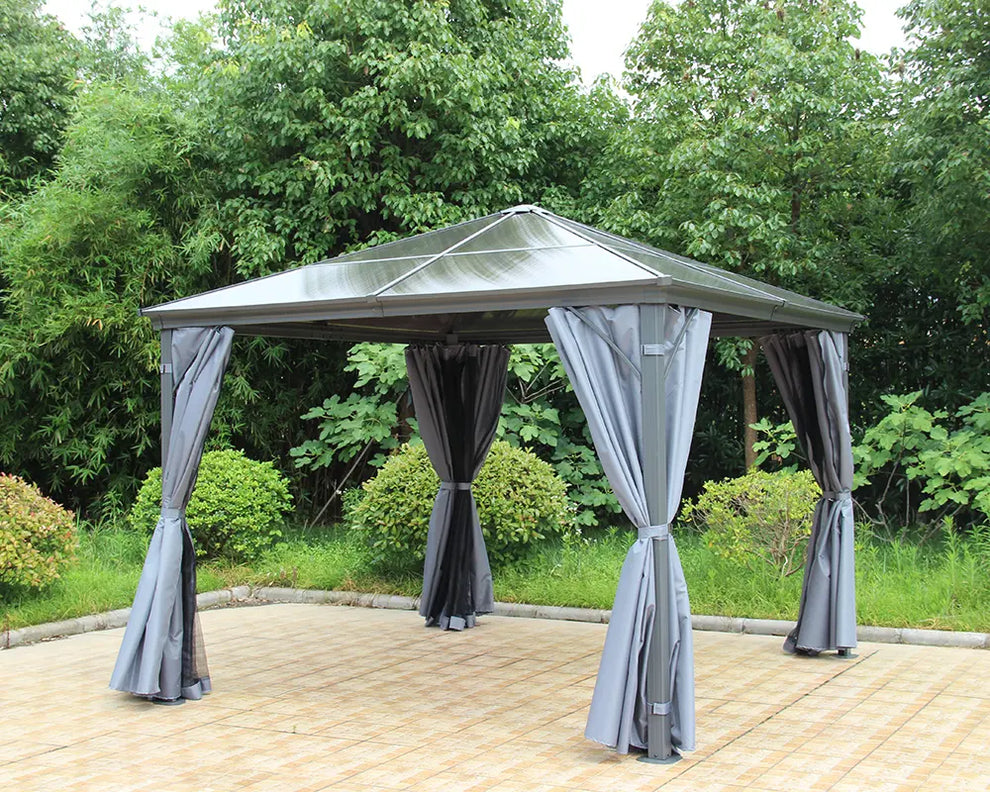
The Lugano 3m x 3m Grey Aluminium Polycarbonate Gazebo shows how well this works in practice. It's a solid 3 metre square gazebo with a quality polycarbonate roof, but the included curtains are what make it particularly versatile. On a breezy day, close the windward side and suddenly it's much more comfortable. On a hot afternoon, draw the curtains against the sun. In the evening, close them all for a cosy, enclosed feel. The grey aluminium frame looks good too, modern without being too stark.
Net curtains are worth mentioning separately because they solve a very specific problem: insects. British summers might not be scorching, but we do get our share of midges, wasps, and other flying nuisances. Net curtains keep them out whilst still allowing air flow and visibility. You get the outdoor feel without the bugs landing in your drink.
Some polycarbonate gazebos come with integrated guttering systems. This might not sound exciting, but in the UK where we can get some serious rainfall, it's genuinely useful. Guttering channels water away neatly to the corners or one side, preventing drips around the edges and stopping water from splashing back up onto you or your furniture. It also means you can potentially collect rainwater if you're that way inclined.
Build quality on these additional features matters. Cheap curtains will fade and tear within a season. Quality polyester or mesh options, the kind that come with better gazebos, will last for years. Same with integrated guttering, it needs to be properly sealed and positioned to actually do its job rather than leak at the joints.
Choosing the Right Size Polycarbonate Gazebo
Getting the size right is critical. Too small and you'll be constantly wishing you'd gone larger. Too big and it dominates your garden, leaving you with awkward unusable spaces around the edges.
Start by measuring your outdoor space properly. Don't just pace it out, grab a tape measure and get accurate dimensions. Then mark out the footprint of the gazebo you're considering. You can use bamboo canes at the corners with string between them, or even just lay out rope or hose pipe to show the perimeter. Live with this marking for a few days, walk around it, visualise your furniture underneath, see how it affects access to other parts of the garden.
Common gazebo sizes and what they actually accommodate:
3m x 3m is your compact option. This is perfect for a 4 to 6 seater dining table with chairs tucked in. You've got enough space to pull chairs out and walk around the table, but not masses of extra room. It works well for smaller hot tubs too, giving you coverage overhead with a bit of clearance. If your garden's on the smaller side or you just want to cover a specific seating area, this size hits the sweet spot.
3m x 3.6m or 3m x 4m gives you more breathing room. Now you're looking at comfortable seating for six to eight people around a dining table, with space to move around properly. Or you could fit a large sofa set with coffee table, maybe a couple of additional chairs. This size also works if you want to create different zones underneath, dining at one end, lounging at the other. It's the size I'd recommend if you do much entertaining or if you want the gazebo to serve multiple purposes.
Larger sizes (4m x 4m and up) are for serious outdoor living spaces or commercial use. You can fit substantial furniture arrangements, maybe an outdoor kitchen setup, or accommodate larger gatherings. These also work well for hot tub shelters where you want plenty of room to move around the tub safely.
Important considerations beyond just floor space:
- Leave walking space around the gazebo. You don't want it butted right up against a fence or wall. Leave at least 30 to 50cm clearance on all sides so you can access it comfortably, clean it if needed, and not feel hemmed in.
- Account for door swing on garden furniture. Chairs need to pull out, tables might have extension leaves, sofas with recliners need extra depth. Factor this into your measurements.
- Height matters too. Standard gazebos are around 2.4 to 2.6 metres high, which gives you plenty of headroom and makes the space feel open. If you're tall or you want to hang lights or plants, consider height carefully. Too low and it feels oppressive. Too high and the proportions can look odd, especially in a smaller garden.
Visualising the gazebo before you buy helps avoid expensive mistakes. Besides marking it out physically, try taking photos of your garden and sketching in where the gazebo would sit. Some online tools let you superimpose structures onto photos, though honestly a rough sketch works just as well.
Martinique 4300 Rectangular Aluminium Grey Gazebo
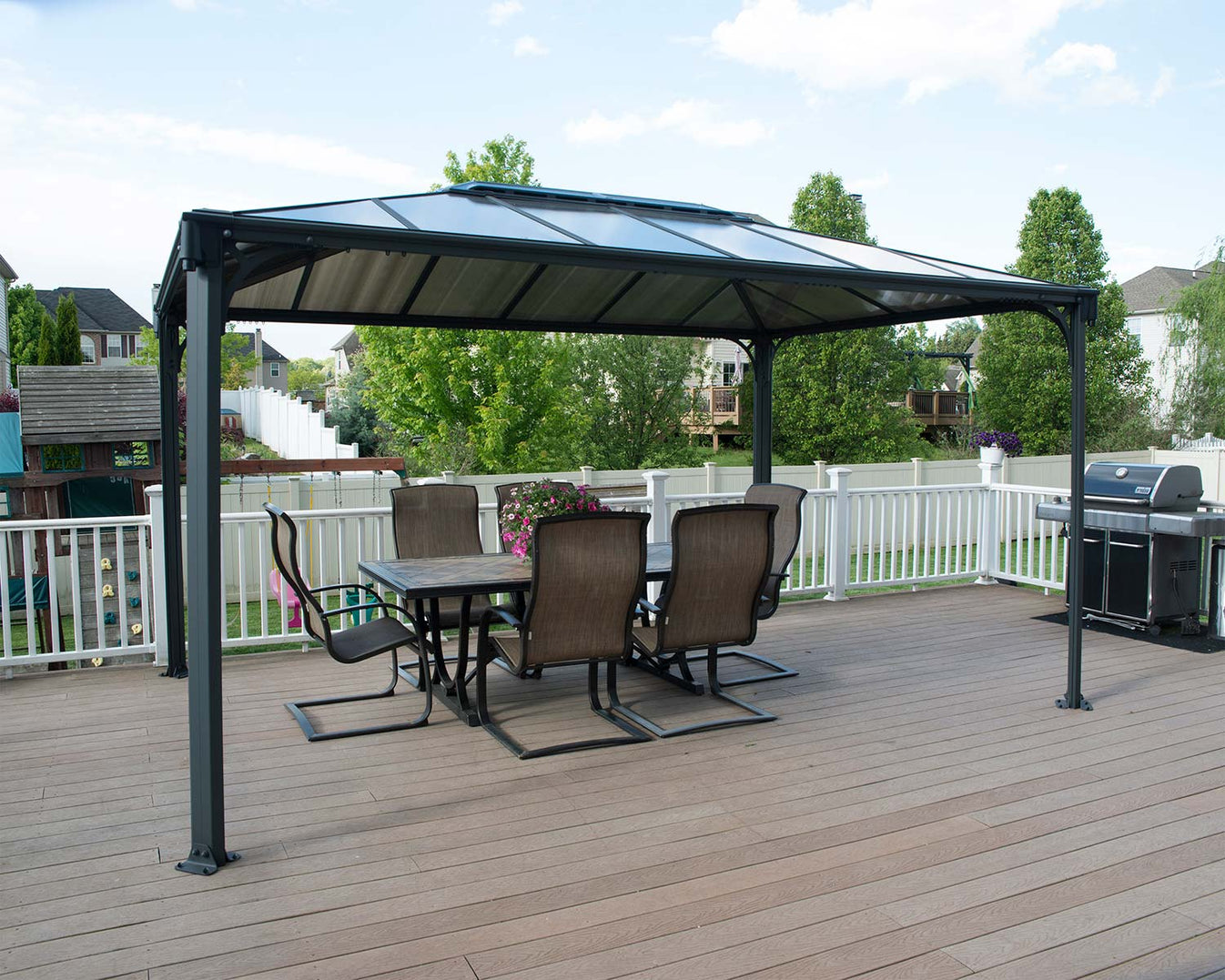
For larger outdoor gardens where you're planning substantial entertaining or want to create a proper outdoor room, something like the Martinique 4300 Rectangular Aluminium Grey Gazebo makes sense. The generous dimensions give you real flexibility in furniture arrangement and use. The powder-coated aluminium construction and polycarbonate roof provide that same weatherproof durability, but on a scale that creates a genuine outdoor living space rather than just a covered corner.
Material Quality: What to Look for in Aluminium Frames and Polycarbonate Panels
Aluminium Frame Construction
Aluminium is the standard frame material for polycarbonate gazebos, and for good reason. It doesn't rust like steel, doesn't rot like wood, and offers an excellent strength-to-weight ratio. But there's aluminium and then there's aluminium.
For UK weather specifically, aluminium beats the alternatives hands down. Wooden gazebos look lovely when new, but our damp climate is murder on them. Even with treatment, you're looking at rot, warping, and constant maintenance. Steel frames rust despite galvanising and paint. Yes, there are heavy duty steel gazebos that last, but they're heavy, harder to install, and still need more upkeep than aluminium.
Powder-coating is what protects the aluminium and gives it colour. This is a dry finishing process where coloured powder is electrostatically applied to the frame, then cured under heat to form a hard, protective layer. It's much more durable than paint, resistant to chipping, scratching, and fading. Most quality gazebos use anthracite grey or bronze powder coating, which looks good and hides the occasional mark better than lighter colours.
Frame thickness and gauge matter for structural integrity. You're looking for frames with walls at least 1mm to 1.5mm thick on the main posts and beams. Some budget models cut corners here, using thinner aluminium that flexes under load or dents easily. Proper heavy duty frames feel solid when you handle them during assembly, there's no flex or wobble.
The rust-free property of aluminium is one of its biggest advantages. You can leave a quality aluminium gazebo outside for twenty years and the frame will still be sound. No rust stains, no corrosion, no structural weakening. This is particularly important where the frame contacts the ground or where water collects.
Polycarbonate Roof Panel Specifications
The polycarbonate panels are what make the roof, so their quality directly affects how well the gazebo performs.
Thickness absolutely matters. You'll see panels ranging from 4mm to 10mm thick, with 6mm to 7mm being the sweet spot for garden gazebos. Thicker panels are stronger, more impact-resistant, and provide better insulation (not that you're heating the space, but they dampen sound better and handle temperature extremes). The 7mm thick polycarbonate panels you find on quality gazebos will shrug off falling branches, hailstones, and the general abuse that British weather throws at them.
Single panels vs double-walled construction is another consideration. Most garden gazebos use solid single panels, which is fine. Double-walled panels (where there's a hollow section with ribs between two layers) offer better insulation and sound dampening, but they're usually overkill for a gazebo unless you're in a particularly extreme climate or under a flight path.
UV protection ratings are standardised. Quality polycarbonate blocks 99.9% of UV rays, which is about as good as it gets. This protects you, your furniture, and actually the polycarbonate itself from degradation. Cheaper panels might claim UV protection but only block 90% or 95%, which means faster fading and more sun damage over time.
Impact resistance is one of polycarbonate's standout features. It's virtually unbreakable under normal use. You'd have to really try to crack or shatter it. This makes it much safer than glass or acrylic, especially if you have kids playing in the garden or if there are trees overhead that might drop branches.
Light transmission vs shade provision is a balancing act, and it depends on what tint you choose. Clear polycarbonate lets through about 80% of light, giving you a bright, airy feel but less shade. Bronze tint drops this to around 50%, providing more shade whilst still being see-through. Grey or smoked panels might only allow 30% to 40% light through, giving you proper shade but a darker feel underneath. For UK gardens where we don't get relentless sun, clear or lightly tinted panels usually work best.
Quality Indicators
When you're comparing gazebos, these are the signs of quality construction:
Warranty information tells you a lot. A manufacturer confident in their materials will offer warranties of 5, 10, even 15 years on the frame and panels. A 90-day warranty or no warranty at all is a red flag, they don't expect it to last.
UK manufacturing vs imported products is a bit of a mixed bag. Some imported gazebos are perfectly good, made to high standards and well-suited to our climate. Others are designed for Mediterranean conditions and struggle with British weather. UK-made or gazebos specifically designed for the UK market are a safer bet, but they do cost more.
Component quality is where you can spot corners being cut. Check the screws, brackets, and fittings. Are they stainless steel or at least properly coated? Are there enough brackets to properly support the roof? Do the joints look solid or flimsy? A gazebo held together with dozens of cheap zinc-plated screws won't last as long as one with proper stainless fixings and engineered brackets.
Popular Uses for Polycarbonate Gazebos in UK Gardens
Once you've got a polycarbonate gazebo up, you'll be amazed how often you use it. Here are the most common uses we see in UK gardens:
Outdoor dining and entertaining is by far the most popular. There's something about eating outside that makes even a simple meal feel special, and with a polycarbonate roof overhead, you can do it regardless of weather. Set up a dining table and chairs underneath, string some lights across, and you've got a proper outdoor dining room. The gazebo keeps off rain, provides shade on sunny days, and creates a defined space that feels intentional rather than just "we've plonked furniture on the patio."
Hot tub shelters are another brilliant use. If you've invested in a hot tub, you know how annoying it is when it's raining and you're sitting there getting pelted whilst trying to relax. A polycarbonate gazebo solves this completely. You stay dry, you can still see the stars on clear nights (the transparent roof is perfect for this), and you don't need to build an expensive outbuilding to house the tub.
Garden bar or outdoor kitchen coverage is becoming more popular as people invest in proper outdoor cooking setups. Whether it's a built-in barbecue, a pizza oven, or just a rolling cart with your grill and prep surface, having it under a gazebo means you can cook outside in any weather. The polycarbonate roof handles the heat from cooking without issues, and you're not abandoning the grill every time it starts spitting rain.
Sheltered seating areas for year-round use make your garden actually usable in autumn and winter. Stick a comfortable sofa set or some lounge chairs under a gazebo, maybe add a patio heater or fire pit nearby, and suddenly you can sit outside in November enjoying a coffee without freezing or getting soaked. This extends your garden season by months, which in the UK is no small thing.
Tucson 5000 Aluminium Grey Gazebo
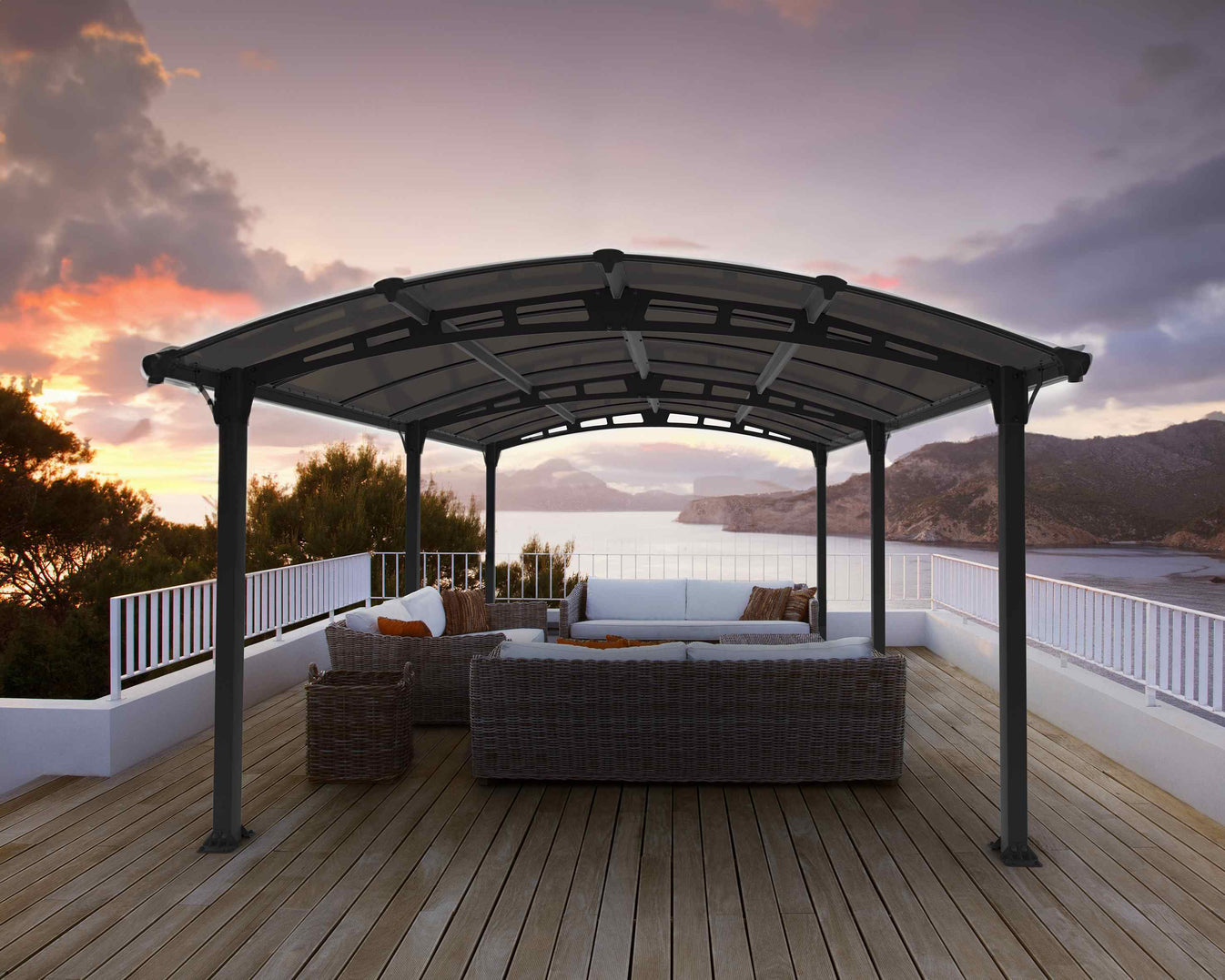
For those serious about creating a year-round outdoor sanctuary, the Tucson 5000 Aluminium Grey Gazebo offers the space and build quality to make it happen. At over 5 metres long and nearly 3.6 metres wide, you've got room for substantial furniture arrangements, multiple seating zones, or a combination of dining and lounging areas. The weather-resistant design and minimal maintenance requirements mean it's there for you in February just as reliably as in July.
Protecting garden furniture might not sound glamorous, but if you've spent good money on outdoor furniture, keeping it under a gazebo dramatically extends its life. Cushions don't fade or go mouldy, wooden furniture doesn't warp or split, metal frames don't corrode. You can leave everything set up and ready to use rather than dragging it in and out of storage.
Designated smoking shelters are useful if you have smokers in the house but prefer they don't smoke indoors. A gazebo gives them a comfortable, dry spot that's technically outside but much more pleasant than standing in the rain.
Children's play areas benefit from weatherproof coverage too. Whether it's a sandpit, outdoor toys, or just a space for them to play, having it under a polycarbonate gazebo means they can use it more often. The UV protection is particularly valuable here, protecting their delicate skin during summer.
Workshop or hobby space extensions work surprisingly well. If you've got a shed that's a bit cramped or you need covered space for messy projects, a gazebo adjacent to your shed or garage creates a sheltered work area. The natural light coming through the polycarbonate roof is brilliant for detailed work, much better than being cooped up inside.
Each of these uses benefits specifically from having a polycarbonate roof rather than fabric or solid metal. You get weather protection without losing natural light, which makes the space feel open and usable rather than dim and enclosed.
Additional Features to Consider
Curtains and Side Panels
We've touched on this already, but it's worth going deeper because curtains really do make a polycarbonate gazebo more versatile.
Privacy is the first benefit. If you're overlooked by neighbours or your garden backs onto a public area, having the option to draw curtains creates a much more intimate space. You can relax without feeling like you're on display, and that makes a surprising difference to how comfortable you feel using the gazebo.
Weather protection is the practical side. British weather comes from every direction. You might have a polycarbonate roof keeping rain off from above, but horizontal rain driven by wind is a different story. Curtains on the windward side block this completely. Same with low-angle sun, early morning or late afternoon sun can shine straight underneath the roof, but curtains block it.
Insect screening with net curtains is brilliant during summer months. You can sit out on a warm evening with all the curtains drawn (the mesh ones, not the solid ones) and enjoy the fresh air without mosquitoes, midges, or wasps bothering you. It's like having a screened porch, a feature that's common in other countries but rare here.
Removable vs permanent options is worth considering when you're buying. Some gazebos have curtains that hook on and off easily, which is convenient if you want to take them down for cleaning or storage. Others have curtains that are more permanently attached, which looks neater and means they're always there when you need them.
Material types matter for longevity. Cheap polyester curtains fade in sunlight and tear easily. Quality outdoor curtains made from UV-resistant polyester or acrylic fabrics will last for years. Mesh net curtains should have reinforced edges and proper fixings, not just cheap netting that rips the first time you touch it.
Integrated Guttering and Drainage
This is one of those features you don't appreciate until you've stood under a gazebo without it during a downpour. Water running off the roof panels needs to go somewhere, and without guttering, it just drips around the perimeter, splashing back onto you, your furniture, and creating puddles at the base of the posts.
For UK rainfall levels, proper water management is essential. We can get some seriously heavy rain, the kind where guttering really earns its keep. Integrated guttering channels water neatly to downpipes at one or more corners, where it can drain away harmlessly.
How guttering systems work with polycarbonate gazebos varies by model. Some have visible guttering along the edges, aluminium channels that match the frame. Others have concealed guttering where the roof panels slope slightly towards channels hidden in the frame. Both work fine, it's mainly an aesthetic choice.
Preventing water pooling on the roof is another benefit of proper design. The panels should have a slight pitch (usually around 5 to 10 degrees) so water runs off rather than sitting in the middle. Guttering collects this runoff before it becomes an issue.
You can potentially connect downpipes to water butts if you're into water conservation, giving you free rainwater for the garden. In a typical British summer (or autumn, or spring, or winter), you'll collect quite a lot.
Anchoring and Stability Systems
A polycarbonate gazebo is only as good as its anchoring. Doesn't matter how strong the frame or how thick the panels are if the whole thing can blow over in a gale.
Ground anchoring methods depend on what surface you're installing on. For soil or lawn, you'll use ground stakes, long metal spikes that drive into the earth through brackets on the posts. For hard surfaces like concrete, paving slabs, or decking, you'll use bolts drilled into the surface or weight plates.
Weight plates are heavy flat plates that bolt to the base of each post. They work through sheer weight, keeping the gazebo in place. They're not as secure as bolts into concrete, but for decking or rented properties where you can't drill into the surface, they're a decent option.
Wind resistance ratings are usually specified by the manufacturer. A properly anchored quality gazebo should handle winds up to 60 to 70mph, which is stronger than most storms we get. Importance of correct installation can't be overstated though, even the best gazebo will fail if you've only put in half the fixings or haven't tightened everything properly.
Lighting and Electrical Integration
Creating ambiance for evening use transforms your gazebo from functional to magical. Even simple fairy lights strung across the underside of the roof make the space feel cosy and inviting.
Pre-wired options are available on some high-end gazebos, with integrated LED lighting built into the frame or roof structure. These are convenient but limit your flexibility in choosing your own lighting.
Most people add their own lighting after installation. Solar lighting is the easiest option, no wiring required. You can get solar string lights, lanterns, or even solar-powered spotlights that clip onto the frame. They charge during the day and automatically light up at dusk.
If you want mains-powered lighting, you'll need to run a weatherproof cable from your house or a garden power point. This is where an electrician is worth their fee, outdoor electrical work needs to be done properly and safely. But once it's in, you can have proper LED downlighters, dimmer switches, the works.
Polycarbonate Gazebos vs Other Garden Shelter Options
Let's be honest about how polycarbonate gazebos compare to the alternatives. Each type of shelter has its place, but for most UK gardens, polycarbonate offers the best balance of features.
| Feature | Polycarbonate Gazebo | Pop Up Gazebo | Wooden Gazebo | Steel Hardtop Gazebo | Fabric Canopy |
|---|---|---|---|---|---|
| Durability | 15-20+ years | 2-3 years | 10-15 years with treatment | 10-15 years | 1-2 years |
| Weather Resistance | Excellent (waterproof, UV-resistant) | Poor (tears, leaks) | Good (requires treatment) | Good (can rust) | Poor (fades, tears) |
| Maintenance | Very low | Medium (replace frequently) | High (annual treatment) | Medium (rust prevention) | High (clean, store, replace) |
| Cost | £600-£2,200 | £100-£400 | £800-£3,000+ | £1,000-£3,500 | £80-£300 |
| Permanence | Permanent structure | Temporary | Permanent | Permanent | Temporary |
| Aesthetics | Modern, clean lines | Basic, utilitarian | Traditional, classic | Contemporary | Basic |
Polycarbonate gazebos are the permanent weatherproof option with minimal maintenance. They handle British weather brilliantly, last for decades, and look good throughout. The polycarbonate roof provides weather protection without blocking light. Downsides are the initial cost and the fact that they're permanent, you can't just move them easily.
Pop up gazebo options are cheap and portable, which is their only real advantage. For occasional use, a party once or twice a year, they're fine. But they tear, leak, fade, and collapse in wind. Honestly, if you're using outdoor space regularly, a pop-up is a false economy. You'll replace it every couple of years and still have a worse experience than a proper permanent gazebo.
Wooden gazebos look lovely and suit traditional garden styles beautifully. But in the UK's damp climate, they're work. Annual treatment with preservative or stain, checking for rot, replacing boards eventually. Some people love this, the maintenance is part of caring for the garden. But if you want low-fuss, wood isn't it. They're also expensive for quality timber construction.
Steel hardtop gazebos with solid metal roofs are strong and give complete shade. But they're dark underneath, you lose all natural light. They're also heavy, making installation harder, and despite powder coating, steel can rust over time, especially at joints and fixings. They work well for specific uses like covering a dedicated outdoor kitchen where you want complete rain protection and don't care about natural light.
Fabric canopy gazebos (the mid-range ones, not pop-ups) last a bit longer but still suffer from the same issues. Fabric fades in sun, tears in wind, needs taking down for winter or replacing every few seasons. The only advantage is they're slightly more attractive than pop-ups and pack down smaller for storage.
When each type makes most sense:
- Choose a polycarbonate gazebo for permanent outdoor living space, year-round use, and low maintenance
- Choose a pop-up for genuinely occasional use or if you need something portable for events
- Choose wooden if you love the traditional aesthetic and don't mind the maintenance
- Choose steel hardtop if you need complete shade and weather protection for specific purposes
- Choose fabric if you're on a tight budget and only use it occasionally
For most UK gardens where you want to actually use the space regularly throughout the year, polycarbonate offers the best balance. You get weatherproofing, durability, natural light, and minimal maintenance. The long-term value proposition is hard to beat, the upfront cost is higher than cheap alternatives, but over 15 to 20 years of use, the cost per year is lower than repeatedly replacing budget options.
Installation and Assembly Guide
Installing a polycarbonate gazebo is well within the capabilities of a competent DIYer, but it's not a quick afternoon job. Here's what to expect.
The typical installation process starts with preparing your base. The gazebo needs a level surface, whether that's concrete, paving slabs, decking, or even compacted hardcore. Levelling is critical. A wonky gazebo looks terrible and can stress the frame unevenly. Use a spirit level and take your time getting this right.
Next comes laying out all the components. Quality gazebos come with all parts labelled and instructions that match. Spread everything out, check you've got all the pieces against the parts list, and familiarise yourself with the instructions before you start.
Frame assembly usually starts with the base or posts. You'll connect corner posts to base plates or feet, then add cross-beams and supports to create the basic structure. This is typically when you'll do the actual anchoring too, before the roof goes on whilst you can still easily access the fixings.
Roof panel installation comes once the frame is up and secured. Polycarbonate panels slot into channels in the frame, usually with sealing strips or gaskets to keep water out. You'll work from one side to the other, overlapping panels slightly (if required by your model) and securing them with the provided fixings. Don't overtighten screws on polycarbonate, you can crack it. Snug is fine.
DIY vs professional installation depends on your confidence and abilities. If you're handy, have a mate who can help, and have the time, go for it. The money saved is substantial. But if you're not confident about levelling, drilling into concrete, or working at height, getting a professional is worth it. Many companies offer installation services for a few hundred pounds, which seems reasonable when you've spent over a grand on the gazebo itself.
Tools commonly required include:
- Electric drill with various bits (masonry bits if fixing to concrete)
- Spirit level (a long one, 1.2m or more)
- Spanners or socket set for bolts
- Screwdrivers
- Tape measure
- Rubber mallet (for tapping joints together)
- Ladder or step stool
- Possibly a saw if you need to trim any components
Time investment is typically 4 to 8 hours with two people for a standard-sized gazebo. Larger models or if you're new to this sort of thing, allow a full day. Don't rush it. It's better to take an extra couple of hours and get it right than to rush and have panels not sealing properly or the frame not quite square.
Foundation preparation is crucial. For concrete or existing paving, check it's level and in good condition. For decking, ensure the structure underneath can support the gazebo, you may need additional joists. For grass or bare ground, you'll need to create a level base, either by laying paving slabs, pouring a concrete pad, or using a compacted hardcore base with paving on top.
Safety considerations during assembly include working in calm weather (don't try to install polycarbonate panels in high wind), having someone help (these are two-person jobs, minimum), and being careful with the panels (edges can be sharp until trimmed). If working at height, use a stable ladder or work platform.
When to seek professional help: if you're unsure about any aspect, if the ground isn't level and you don't know how to fix it, if you're installing on a sloped site, or if the gazebo is particularly large or complex. There's no shame in getting help, and a properly installed gazebo will last decades whilst a bodged one gives constant problems.
Tips for easier assembly: read all instructions before starting, lay out components in the order you'll need them, don't fully tighten bolts until everything's together (leaving them loose lets you adjust alignment), work on a calm day, and have refreshments on hand. Installing a gazebo is work, but it's quite satisfying when you step back and see it standing there, solid and ready for use.
Maintenance and Care for Your Polycarbonate Roof Gazebo
One of the best things about polycarbonate gazebos is how little maintenance they need. But "minimal" isn't "zero," so here's what you should do to keep yours in top condition.
Cleaning polycarbonate panels is straightforward. A couple of times a year, give them a wash with warm water and a tiny bit of washing-up liquid. Use a soft brush or cloth, never anything abrasive. Hose them down to rinse, job done. This removes dirt, pollen, bird droppings, and general grime that accumulates. If you've got tree sap or stubborn marks, a bit of white vinegar in water works brilliantly.
Avoiding scratches and damage means being gentle. Don't drag branches or tools across the roof. When cleaning, use soft materials only, no scouring pads or stiff brushes. If you need to remove snow, use a soft broom rather than a metal shovel. Polycarbonate is tough but it can scratch, and whilst small scratches don't affect performance, they look untidy.
Aluminium frame maintenance is even simpler. Wipe it down when you're cleaning the roof. Check for any marks or scuffs, though powder-coated aluminium is pretty resistant to this. If you do get a scratch that goes through to bare metal, you can touch it up with matching paint to prevent oxidisation, though honestly aluminium doesn't rust so it's mainly cosmetic.
Seasonal checks are worth doing, especially before winter and after big storms. Walk around the gazebo checking that all bolts and fixings are still tight. Look for any damage to panels or frame. Check guttering is clear of leaves and debris. Make sure drainage is working properly. These checks take ten minutes and can prevent small problems becoming big ones.
Gutter clearing is important if your gazebo has integrated guttering. Leaves, especially in autumn, can block downpipes. A quick poke with a stick or blast with the hose keeps things flowing. Blocked gutters mean water overflows or backs up, which can cause drips where you don't want them.
Curtain and net care depends on the material. Most outdoor curtains can be removed and machine washed on a gentle cycle once or twice a year. Hang them back up whilst still slightly damp so they dry in shape. Net curtains are the same, though they're more delicate so use a laundry bag. If curtains aren't removable, you can usually wipe them down with a damp cloth or use a garden hose on a gentle spray setting.
Tightening bolts and fittings annually is good practice. Things can work slightly loose over time, especially after a winter of freeze-thaw cycles. Go round with a spanner and check everything's snug. Don't go mad and overtighten, just make sure nothing's rattling or coming loose.
Expected lifespan with proper care is genuinely impressive. The polycarbonate panels should last 15 to 20 years minimum, often longer. The aluminium frame will last even longer, 20 to 30 years isn't unrealistic. Curtains and soft furnishings you might replace every 5 to 10 years depending on quality and UV exposure, but the structure itself is a long-term investment.
When to replace components: if polycarbonate panels crack or become very cloudy (rare, but it can happen after decades of use), they're replaceable. If curtains tear or fade beyond redemption, replace them. If fixings rust (shouldn't happen with stainless steel, but cheaper fixings might), replace them. The beauty of a well-designed gazebo is that individual components can be swapped out without replacing the whole thing.
Honestly, compared to wooden structures that need annual treatment or fabric gazebos that need constant attention, a polycarbonate gazebo is wonderfully low-maintenance. An hour or two of care per year and it'll serve you brilliantly for decades.
Patio Covers and Extended Outdoor Living Solutions
Whilst freestanding gazebos are brilliant, patio covers attached to your house offer a different set of benefits that work particularly well for certain situations.
Patio covers differ from traditional gazebos in that they're essentially outdoor room extensions. Rather than a separate structure in your garden, they're attached to your house wall, creating a sheltered area right outside your back door. Think of it as halfway between a gazebo and a conservatory.
Wall-mounted and lean-to options use your house wall as one side of the structure, with posts supporting the front edge and a sloped polycarbonate roof covering the space between. This means you've got three sides open to the garden (you can add curtains or side panels if you want) and one side against your house.
Creating seamless indoor-outdoor transitions is where these really excel. You open your back door and step straight into covered space. No running across the patio in the rain. In summer, you can leave the door open and the two spaces flow together, making your living area feel much larger. It's particularly good if your house backs onto the garden with French doors or bifolds, the covered patio becomes an extension of your living room or kitchen.
Sierra Aluminium 2.3m x 2.3m Grey Polycarbonate Patio Cover

For smaller gardens or compact patios, the Sierra Aluminium 2.3m x 2.3m Grey Polycarbonate Patio Cover is a smart solution. At just 2.3 metres square, it doesn't dominate your space but still provides useful coverage. The UV-resistant polycarbonate panels and rust-free aluminium frame give you the same weatherproof reliability as a freestanding gazebo. The adjustable height poles mean you can tailor it to your specific wall height and door configuration, which is handy given that not all houses are built to the same dimensions. Assembly is straightforward enough for a DIY installation, and once it's up, the low-maintenance nature means you're not adding another job to your weekend list.
Benefits for smaller gardens or terraced houses are significant. If you've only got a small patio, a freestanding gazebo might take up too much of your precious outdoor space. A wall-mounted patio cover uses vertical space instead, leaving more of your garden available. For terraced houses where gardens are often narrow, this can make the difference between having a usable covered area and not.
Sierra Aluminium 2.3m x 6.9m Grey Polycarbonate Patio Cover
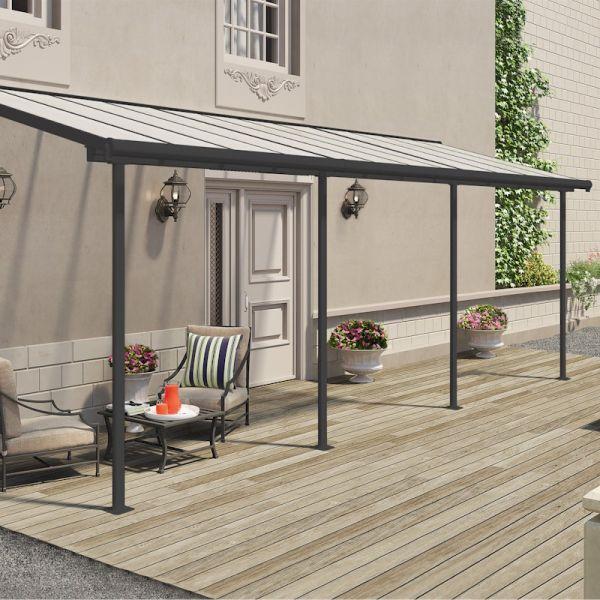
When you've got more wall space available and want to cover a larger patio area, the Sierra Aluminium 2.3m x 6.9m Grey Polycarbonate Patio Cover offers impressive coverage whilst maintaining that same lean-to design. Nearly 7 metres of length means you can shelter a substantial outdoor dining area, comfortable seating, or even an outdoor kitchen setup. The lightweight polycarbonate roof panels still allow natural light through whilst providing UV protection and keeping rain off. The rust-free construction and minimal maintenance requirements are the same as with smaller models, you're just working at a larger scale.
Year-round patio usage becomes genuinely viable with a good patio cover. British weather makes uncovered patios unusable for much of the year, but with a polycarbonate roof overhead, you can be out there in October drizzle, February cold snaps (add a patio heater), or August downpours. The space becomes a genuine outdoor living area rather than somewhere you only use on the handful of perfect weather days we get each year.
Installation of wall-mounted covers requires proper weatherproofing where the structure meets your house. Flashing (usually aluminium) directs water away from the joint, and silicone sealant fills any gaps. If you're not confident doing this, it's worth getting a professional, a leak at this junction can cause damp problems in your house.
The versatility of patio covers means they suit various situations: creating a covered pathway from your back door to a garage or garden office, sheltering outdoor furniture that sits right by the house, covering a barbecue area so you can cook regardless of weather, or simply creating a covered spot to stand whilst you put your boots on or unload shopping.
They work particularly well in combination with freestanding gazebos too. You might have a patio cover by the house for everyday use and a freestanding gazebo further down the garden for entertaining or as a hot tub shelter. Different zones, different purposes, both adding to how you use your outdoor space.
Budgeting for Your Polycarbonate Roof Gazebo
Let's talk money. Polycarbonate gazebos aren't the cheapest garden structures, but understanding what you're actually paying for helps make sense of the pricing.
Typical price ranges break down roughly like this:
Entry-level (£600-£900): At this price point, you're looking at smaller gazebos, usually 3m x 3m or compact lean-to designs. The frame will be aluminium and the roof will be polycarbonate, so you're getting the basic benefits of the design. Quality can vary, some are genuinely good value, others are cutting corners. Check panel thickness (6mm minimum), frame quality (should feel solid), and what's included. Curtains, guttering, and quality fixings add value.
Mid-range (£900-£1,500): This is the sweet spot for most people. You'll get better build quality, thicker polycarbonate panels (7mm), sturdier frames, and often additional features like curtains or integrated guttering. Size options increase too, with 3m x 3.6m and larger rectangular models available. Brands at this level usually offer better warranties and customer service.
Premium (£1,500+): Here you're paying for larger sizes, top-quality materials, additional features, and often better design. Frames might be heavier gauge aluminium with more substantial fixings. Panels could be 8mm or thicker. You might get features like built-in LED lighting, superior guttering systems, or particularly attractive design details. Installation services are sometimes included or available at this level.
What affects pricing beyond just the base cost:
- Size is the obvious one. More materials cost more. A 5m x 3.6m gazebo will cost significantly more than a 3m x 3m, even from the same manufacturer with the same quality.
- Features add up. Curtains cost money. Integrated guttering costs money. Quality powder coating costs more than basic finishes. If you want all the extras, expect to pay for them.
- Brand matters to some extent. You're paying for the company's reputation, their customer service, their warranty, and the development they've put into the design. A well-known brand with proven reliability in the UK market is worth something.
- Material quality is where you can really see price differences. Thicker panels, heavier frames, stainless steel fixings, UV-resistant curtains, all of these cost more to produce and buy.
Additional costs to factor in beyond the gazebo itself:
- Base or foundation: If you need to lay paving slabs or pour a concrete pad, budget £200 to £500 depending on size and existing ground conditions. If you're installing on existing paving or decking, this cost disappears.
- Installation: Professional installation runs £200 to £500 typically, depending on gazebo size and complexity. DIY saves this entirely but costs you time and effort.
- Anchoring systems: If you need weight plates instead of ground anchoring, budget £50 to £150 for a set. Most gazebos include basic anchoring.
- Accessories: Lighting, additional curtains, side panels if not included, furniture to go underneath, these can add hundreds to your total project cost.
Value for money compared to cheaper pop-up alternatives is where the maths gets interesting. A decent pop-up gazebo costs £150 to £300. Sounds great until you realise you'll replace it every 2 to 3 years. Over 15 years, that's 5 to 7 replacements, costing £750 to £2,100. Plus the hassle of setting up and taking down, storing it, dealing with it tearing or breaking.
A £900 polycarbonate gazebo used for the same 15 years works out to £60 per year. Less than you'd spend on a couple of decent pizzas. Factor in that you'll actually use it more because it's always there and works properly, and the value proposition becomes compelling.
Long-term cost savings come from durability and low maintenance. You're not replacing panels, you're not re-treating the frame, you're not buying new covers. The only ongoing cost is maybe cleaning supplies (soap and water) and possibly replacing curtains after a decade.
When to invest more: if you're planning to use the gazebo heavily, if you want specific features, if your garden is your pride and joy and you want it to look right, or if you're planning to stay in your house long-term. Spending an extra few hundred quid for a gazebo that'll last 20 years instead of 15 makes sense.
When budget options work well: if you've got a genuinely tight budget and need cover sooner rather than later, if you're not sure how much you'll use it, or if you're renting and might move in a few years. But even then, a mid-range polycarbonate gazebo is portable enough to take with you if you move to another property with a garden.
Frequently Asked Questions About Polycarbonate Roof Gazebos
Do I need planning permission for a polycarbonate gazebo?
In England, most garden gazebos fall under permitted development rights, meaning you don't need planning permission. The key criteria are that the structure must be less than 3 metres high (most are around 2.4 to 2.6 metres), it can't cover more than 50% of your garden area, and it can't be forward of the main front wall of your house.
However, there are exceptions. If you live in a conservation area, have a listed building, or your property has specific planning conditions, you might need permission. Some developments have covenants that restrict what you can build. When in doubt, check with your local council's planning department. A quick phone call or email can save you the hassle of having to remove a gazebo later.
For most people in standard residential properties, a polycarbonate gazebo in the back garden won't require permission. But it's always worth checking, especially if you're installing a particularly large one or you live somewhere with special designations.
How long do polycarbonate roof panels last?
Quality polycarbonate panels should last 15 to 20 years minimum, with many exceeding this by quite a bit. I've seen well-maintained gazebos with 25-year-old panels that are still doing fine.
Factors affecting longevity include UV exposure (south-facing roofs in full sun age slightly faster), impact damage (branches falling on them, though they're very impact-resistant), and cleaning methods (abrasive cleaners can scratch and degrade the surface over time).
The UV coating on the polycarbonate is what prevents degradation. Cheap panels without proper UV protection will yellow and become brittle after 5 to 10 years. Quality panels with UV coating maintain their clarity and strength for decades.
Warranty considerations tell you a lot about expected lifespan. If a manufacturer offers a 10 or 15-year warranty on the panels, they're confident they'll last. Short warranties or no warranty suggests the panels aren't expected to last long.
Can polycarbonate gazebos withstand strong winds?
Yes, when properly anchored, a quality polycarbonate gazebo can handle strong winds. Most are rated for winds up to 60 to 70mph, which is stronger than the vast majority of UK storms.
The key phrase there is "when properly anchored." A gazebo that's just sitting on the ground with no fixings will blow over. But one that's bolted into concrete, secured with proper ground anchors, or weighted down with appropriate weight plates will stay put.
The solid polycarbonate roof actually helps with wind resistance in some ways. Unlike fabric that billows and flaps, creating variable forces, the solid panels present a consistent surface. Wind flows over and around them more predictably. The aluminium frame distributes these forces evenly when the structure is properly assembled.
Importance of correct installation can't be overstated. Follow the manufacturer's instructions for anchoring. Use all the fixings provided. Ensure the frame is square and level. These things make the difference between a gazebo that shrugs off gales and one that ends up in your neighbour's garden.
Are polycarbonate gazebos completely waterproof?
Yes, when properly installed, polycarbonate gazebos are completely waterproof. The panels themselves are impermeable to water. The seals between panels, when correctly fitted, keep water out. And if the gazebo has integrated guttering, water is channelled away neatly.
Proper installation is critical. Panel overlaps need to be correct. Sealing strips or gaskets need to be in place. The roof needs to have enough pitch that water runs off rather than pooling. If you've assembled it correctly, you won't get drips or leaks.
Sealed panel joints are where potential problems arise with poor installation. If panels aren't seated properly in their channels, or if sealing strips are missing or damaged, water can seep through. This is why following assembly instructions carefully matters.
Guttering importance ties into overall waterproofing. Even if the roof itself is perfectly waterproof, without guttering you'll get drips from the edges as water runs off. Integrated guttering channels this away, keeping the space underneath completely dry.
Can I attach a polycarbonate gazebo to my house?
Yes, lean-to and wall-mounted polycarbonate gazebos are specifically designed for house attachment. They're brilliant for creating covered patio areas right outside your back door.
Considerations for house attachment include proper weatherproofing at the junction between gazebo and wall. You'll need flashing to direct water away and sealant to fill gaps. The attachment points need to be solid, fixing into masonry or structural wall elements rather than just render or cladding.
You'll also need to think about drainage. Water running off the lean-to roof needs to go somewhere, preferably into guttering that channels it away from your house foundations.
Most wall-mounted gazebos come with all the necessary brackets and fixings for house attachment. Installation is slightly more involved than a freestanding model but still manageable for a competent DIYer. If you're not confident drilling into your house wall and ensuring weatherproof seals, getting a professional is sensible.
How do I clean polycarbonate panels?
Cleaning polycarbonate is simple: warm water, a tiny bit of washing-up liquid, a soft brush or cloth, and a hose to rinse. Do this a couple of times a year and your panels will stay clear and attractive.
What to avoid is abrasive cleaners, scouring pads, stiff brushes, or pressure washers on high settings. These can scratch the polycarbonate surface. Whilst small scratches don't affect performance, they look untidy and can accumulate dirt.
For stubborn marks like tree sap or bird droppings, let them soak with soapy water for a few minutes before gently wiping. White vinegar diluted with water works well for mineral deposits or water marks.
The UV coating on quality polycarbonate is on the outer surface, so being gentle preserves this protective layer. Scratching through it can lead to faster degradation in that spot.
What's the difference between a gazebo and a pergola?
The traditional distinction is roof coverage. A gazebo has a complete roof, fully covering the space underneath. A pergola has an open-slatted roof or cross-beams, providing partial shade but not complete coverage.
However, with polycarbonate structures, the lines blur. Many are marketed as "pergola gazebos" because they have the styling of a pergola (cross-beams, open sides, architectural detail) but with a solid polycarbonate roof like a gazebo. So you get the aesthetic of a pergola with the weather protection of a gazebo.
In practical terms, if it has a solid roof that keeps rain off, call it a gazebo. If it's got slats or beams with gaps that let rain through, it's a pergola. Many modern polycarbonate structures are technically gazebos but styled to look like pergolas, hence the combined terminology.
Can I use my polycarbonate gazebo in winter?
Absolutely, that's one of their best features. Year-round use is where polycarbonate gazebos really prove their worth compared to seasonal alternatives.
The structure will handle cold temperatures without issues. Polycarbonate doesn't become brittle in cold the way some plastics do. The aluminium frame is unaffected by temperature changes. Snow load is the only consideration, most gazebos can handle typical UK snowfall, but very heavy accumulations should be brushed off.
Winter benefits include having a sheltered outdoor space when you'd otherwise be stuck indoors. Add a patio heater or fire pit nearby and you can sit out there even in January. The polycarbonate roof keeps rain and snow off whilst still letting in what little winter daylight we get.
Many people find their gazebo gets more use in winter than summer. In summer, you can sit anywhere in the garden. In winter, the gazebo is the only comfortable outdoor spot, so it becomes the place to go for fresh air without freezing or getting soaked.
Choosing Your Perfect Polycarbonate Roof Gazebo
So here's where we are. You know what a polycarbonate roof gazebo is, how it handles British weather, what sizes work for different spaces, and what features matter. You understand that quality materials, proper aluminium frames and thick polycarbonate panels, make a genuine difference to longevity and performance. And you've got a realistic picture of costs and what you're actually paying for.
The main benefits bear repeating because they're what make these gazebos worth considering: durability that sees them lasting 15 to 20 years with minimal fuss, weather protection that actually works in our unpredictable climate, UV resistance that protects you and your furniture, and maintenance requirements that amount to a quick clean twice a year. For UK gardens specifically, where we need shelter from rain more often than shade from sun, this combination of features is genuinely useful.
When you're choosing your gazebo, think about these key points. Size needs to fit your garden and your intended use, measure carefully and allow walking space. Features like curtains or side panels make the structure more versatile, so consider what you'll actually need. Budget realistically, factoring in not just the gazebo but installation and any base preparation. And think about intended use, a dining area needs different dimensions than a hot tub shelter or furniture protection.
If you're ready to explore what's available and find the right polycarbonate gazebo for your garden, take a look at our range. We stock quality aluminium gazebos with polycarbonate roofs in various sizes and configurations, all designed to handle British weather and last for years. Your outdoor space is waiting.


